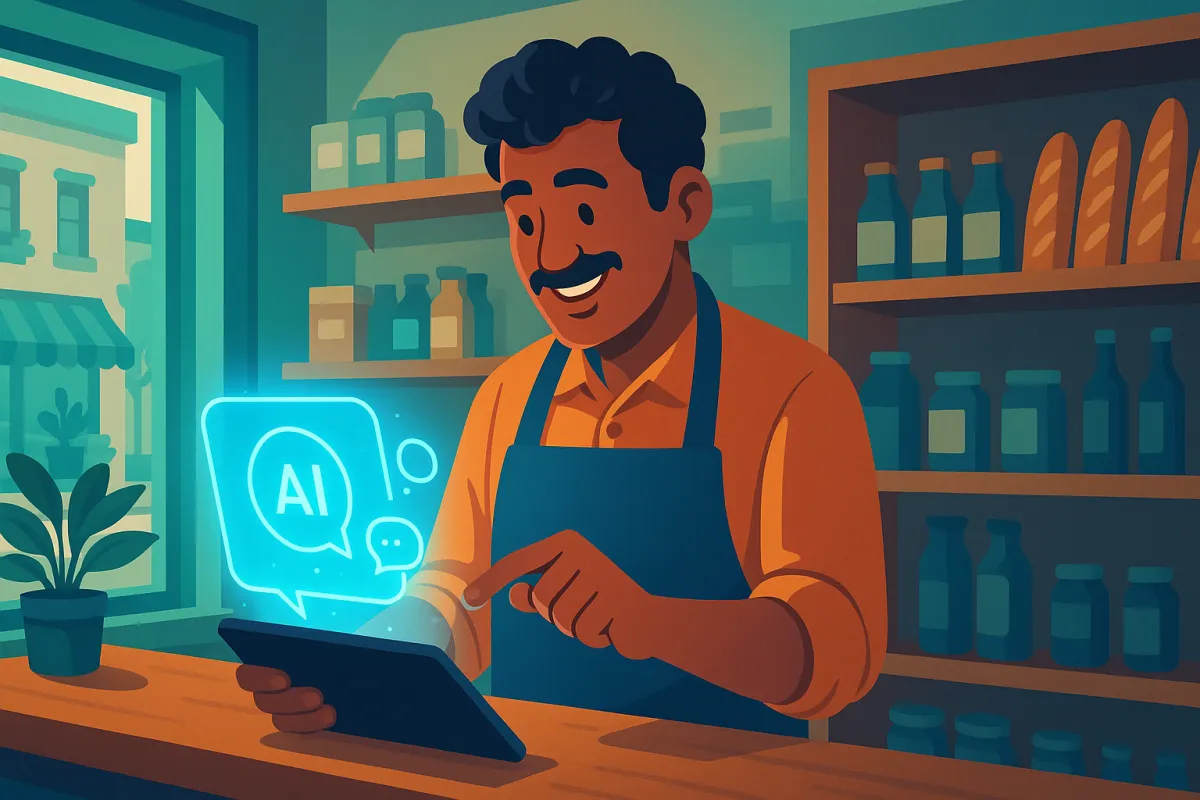
How AI Can Help Your Small Local Business Thrive in a Competitive World
How AI Can Help Your Small Local Business Thrive in a Competitive World
A practical guide to leveraging artificial intelligence without a big tech budget
Running a small local business has never been easy. Between managing staff, serving customers, handling finances, and trying to stay ahead of the competition, the to-do list never seems to shrink. But a quiet revolution is underway — and it's one that small business owners can no longer afford to ignore.
Artificial intelligence (AI) for small business has become remarkably accessible. Today, even a sole-trader bakery or a two-person plumbing company can harness the power of AI tools to work smarter, save time, and grow faster. Here's how.
1. Never Miss a Customer Again with AI-Powered Communication
One of the biggest challenges for small local businesses is being available around the clock. Customers expect fast responses — and if they don't hear back quickly, they'll move on to a competitor.
AI chatbots and virtual assistants can handle customer enquiries 24/7, even when you're closed, on a job, or simply too busy to pick up the phone. They can answer frequently asked questions, collect contact details, book appointments, and even qualify leads before passing them to you.
For a local hair salon, this might mean a customer at 11pm can book a Saturday appointment without you lifting a finger. For a tradesperson, it means capturing a new lead while you're up on a roof. The result? More bookings, fewer missed opportunities, and happier customers — all without hiring extra staff.
2. AI Marketing for Small Businesses That Actually Works
Consistent, quality marketing is what keeps your name in front of local customers — but creating content takes time that most small business owners simply don't have.
AI marketing tools can generate social media posts, email newsletters, promotional copy, and blog articles in a fraction of the time it would take to write them manually. You provide a few key details — your business, the promotion, your tone — and the AI drafts the content for you to review and publish.
Beyond content creation, AI can also help you understand when to post, who to target, and what messages resonate most with your audience. Over time, these insights compound, making your marketing progressively smarter and more effective without increasing your budget.
3. Smarter Customer Relationships with AI-Driven CRM
Your existing customers are your most valuable asset. Studies consistently show that retaining a current customer is significantly cheaper than acquiring a new one. AI-enhanced customer relationship management (CRM) tools help you nurture those relationships at scale.
Imagine automatically sending a personalised follow-up message to a customer two weeks after their last visit, or triggering a special birthday offer without having to manually track hundreds of dates. AI can segment your customer base, identify your most loyal regulars, flag customers who haven't visited in a while, and prompt you to reach out at exactly the right moment.
For a local gym, this could mean an automated re-engagement message to members who haven't checked in for 30 days. For a café, it might be a loyalty reward that lands in a customer's inbox after their tenth visit. Small, thoughtful touchpoints like these build lasting loyalty.
4. Streamlining Operations and Reducing Admin with Business Automation
Administrative tasks — invoicing, scheduling, stock management, expense tracking — quietly consume hours every week. Hours that could be spent serving customers or growing the business.
AI-powered business automation tools can handle much of this invisible workload. Smart scheduling assistants can optimise appointment bookings and reduce no-shows through automated reminders. AI invoice tools can auto-generate, send, and even follow up on unpaid bills. Inventory management systems can predict when you're likely to run low on stock and flag it before you run out.
The cumulative time savings are significant. Even reclaiming just five hours a week frees up 260 hours a year — that's more than six full working weeks you can redirect toward growth.
5. Making Sense of Your Data with AI Analytics
Small businesses generate more data than they realise — sales figures, website visits, customer enquiries, social media engagement, and more. The problem is that most of it sits unused, buried in spreadsheets or scattered across platforms.
AI analytics tools can surface meaningful patterns from this data without requiring you to be a statistician. Which days are your busiest? Which products have the highest profit margins? Which marketing channel brings in the best customers? AI can answer these questions clearly, helping you make better decisions based on evidence rather than gut feeling.
For a local restaurant, this might reveal that Tuesday lunch promotions consistently outperform Friday evening ones — a counterintuitive insight that reshapes how they allocate their marketing spend.
6. How AI Levels the Playing Field for Local Businesses
Perhaps the most exciting thing about AI for local businesses is what it represents: an equaliser.
Large corporations have always had the advantage of scale — entire departments dedicated to marketing, customer service, data analysis, and operations. AI gives small businesses access to capabilities that were previously only affordable at that scale, at a fraction of the cost.
A local physiotherapy clinic can now offer the same seamless online booking experience as a national chain. A neighbourhood florist can run sophisticated email campaigns that rival those of major retailers. A family-run accountancy practice can automate client follow-ups with the efficiency of a large firm.
The playing field isn't perfectly level yet — but it's levelling fast.
Getting Started: You Don't Have to Do It All at Once
The thought of implementing AI tools for your small business can feel overwhelming, but it doesn't have to be. Start with one pain point. Is it customer communication? Try an AI chatbot. Is it marketing? Explore an AI content tool. Is it scheduling? Look at an automated booking system.
Test, learn, and expand from there. The businesses that will thrive over the next decade aren't necessarily the biggest or the best-funded — they're the ones that are willing to adapt, experiment, and embrace the tools available to them.
AI isn't here to replace the heart and hustle of a small local business. It's here to give that hustle a serious upgrade. 🚀
Ready to put AI to work in your business? Start with the tools you already have and build from there — the investment in time today will pay dividends for years to come.